LIVESave the World, live from Salt Lake City during KubeCon · Wed Nov 11, 11:00 MT →
darkshift
infrared 0.1 · by darkshift

Infrared

A control plane where agents do the work and humans make the calls.

Infrared takes a Change from one sentence to production: an architect plans it, AgentRoles build, test and review it, and a person approves it from the evidence. It deploys through gitops, builds the clusters your Products run on, and tells you what happened in words and video.

infrared 0.1, the keynote⤢ fullscreen
What Infrared is, in three minutes. Sound on.
terminal
# one command, then gitops from there on$ ir install --context gke-prod -f infrared.yaml --setup --wait✓ operator, api, ui and mcp on the management cluster✓ forge connected: a GitHub App or Gitea, no personal tokens✓ gitops repo hydrated from the template✓ argo cd synced, infrared adopted$ _
// the idea

Three ideas, held to everywhere.

01 / product firstStart from the Product, not the cluster. A Product is the repos you build, release and change together. Clusters, zones and gitops plumbing exist to serve it.
02 / defined jobs, human gatesAgents do defined jobs as AgentRoles: the builder, the QA engineer, the security reviewer. Humans hold the gates: what gets built, what merges, what reaches production.
03 / evidenceEvery run records what each step did, the verdict it reached, what it cost and the proof it captured, so you approve from evidence rather than from a diff alone.
// one change flow

The same flow for humans and agents.

A Change written by a person and a Change written by an agent get the same reviews, the same evidence and the same approvals. That's what makes it safe to let agents do more.

  1. 01You askOne sentence on a Product's Changes tab, or an issue in your repo.you
  2. 02The architect plans itIt reads your code and turns the ask into an issue with a plan and success criteria.agents
  3. 03You triageBuild it, or hand it to a person. Nothing is built until you say so.you
  4. 04Agents build and reviewThe builder writes it; QA, security and quality reviewers check it and send it back if it isn't right.agents
  5. 05You approve the mergeFrom each step's verdict and evidence, not from a diff alone.you
  6. 06Infrared deploys itZone by zone through gitops, each zone watched by a release guard that rolls back a failure.agents
  7. 07You approve productionProduction waits for a person. Then the Change is Done, with a video of what happened.you
follow one Change, step by step →
// a tour of the app

Laid out the way you work.

The app's left rail follows the order a Change travels in, and so does this tour. Here is each stop.

products

Products

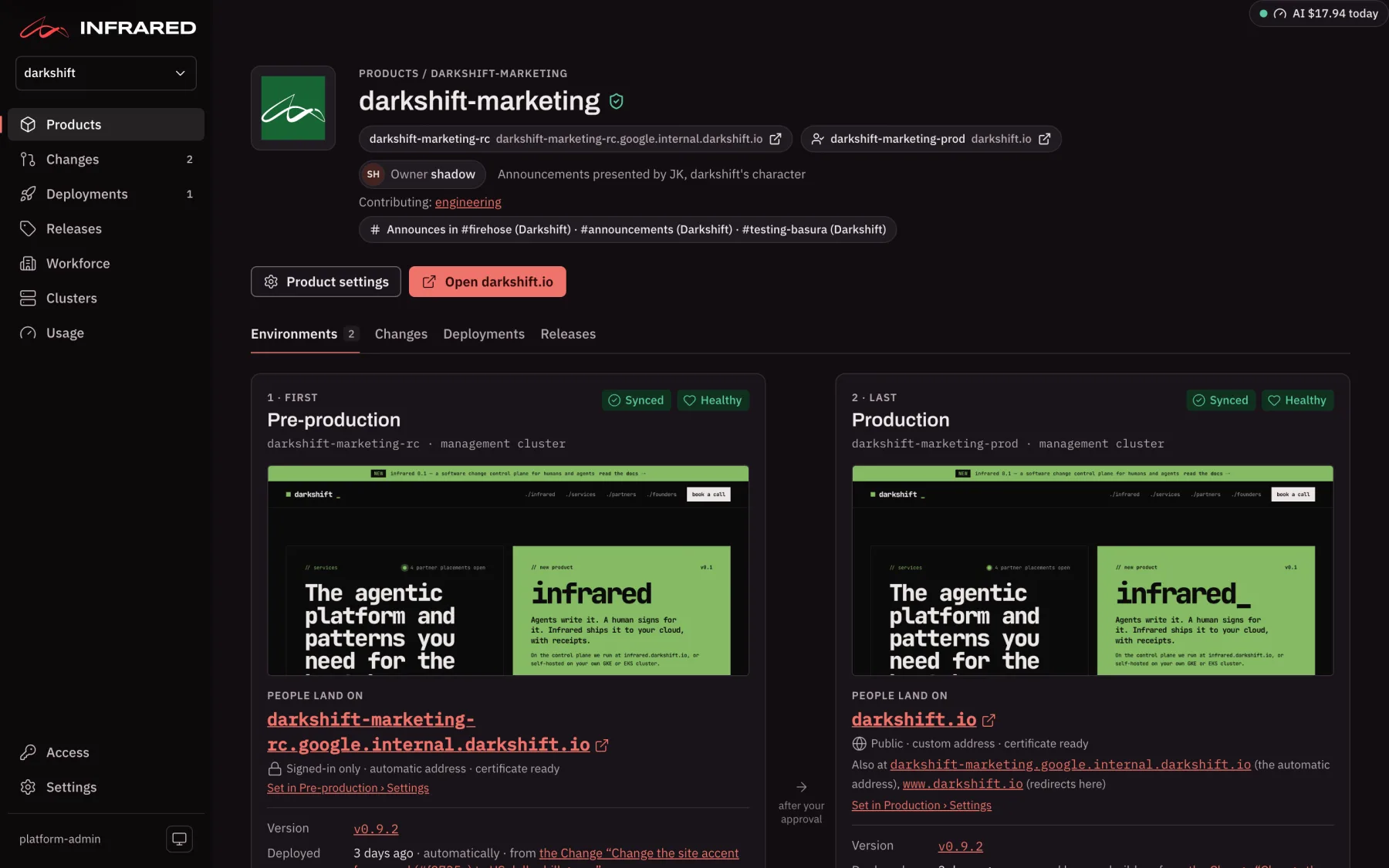
Each Product's environments in promotion order, what they run and whether they're healthy, its Changes, deployments and releases. The top of the page tells the whole org's week, with a video.

  • Environments with their own pages: live pods, history, settings
  • Custom domains with DNS checks that name the record to add
  • Status pages with 30 days of uptime
Products in the docs →
infrared.darkshift.io
A Product's page: its environments in promotion order, each with its version and health
changes

Changes

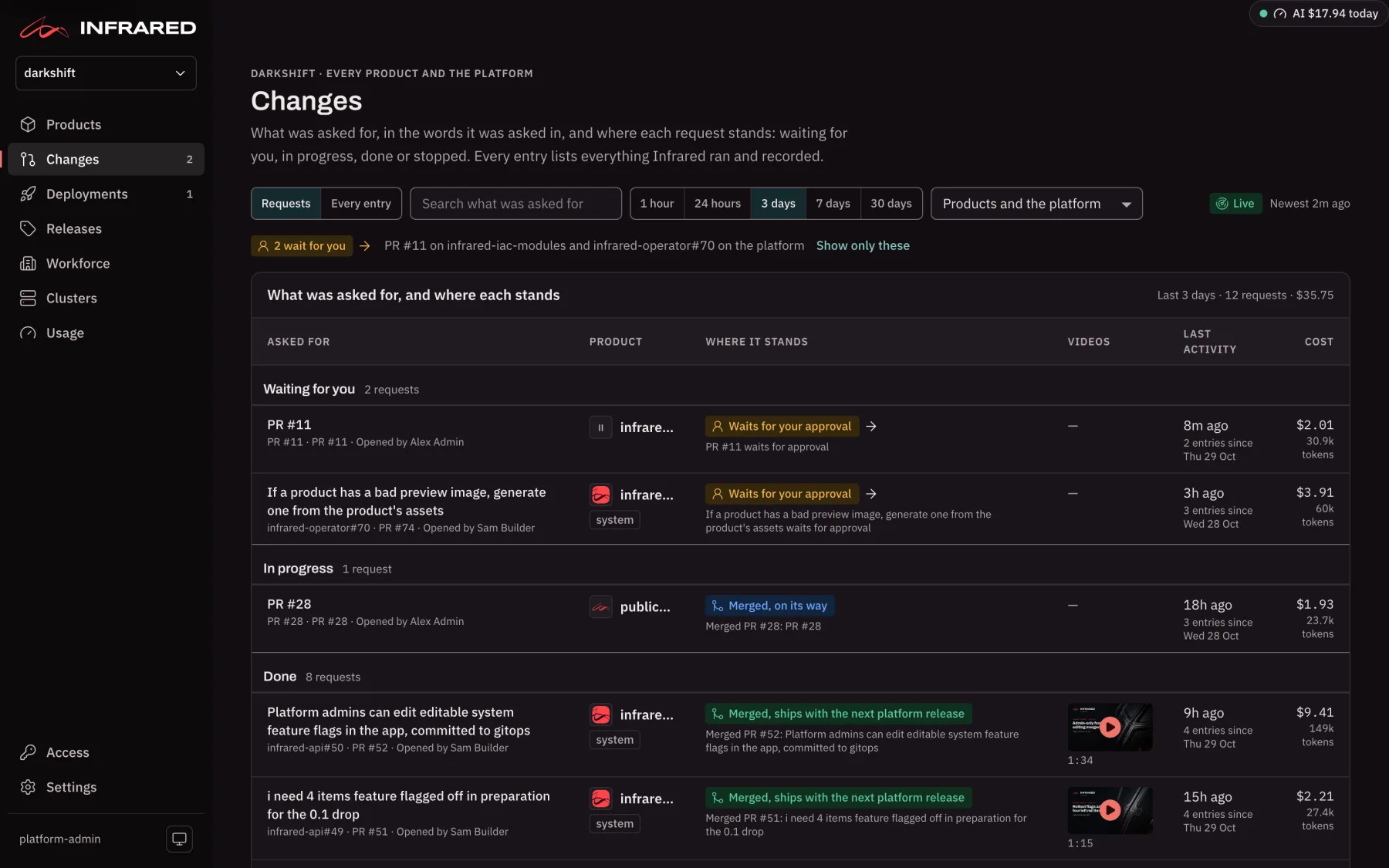
Every request in the words it was asked in, grouped by where it stands, and the full log of every agent run, merge, approval, build, deployment and rollback.

  • The rail counts what waits for you
  • Triage, approve or answer an agent from one place
  • Share any Change to Slack
Changes in the docs →
infrared.darkshift.io
Changes: requests grouped into waiting for you, in progress and done, with their cost and videos
deployments

Deployments

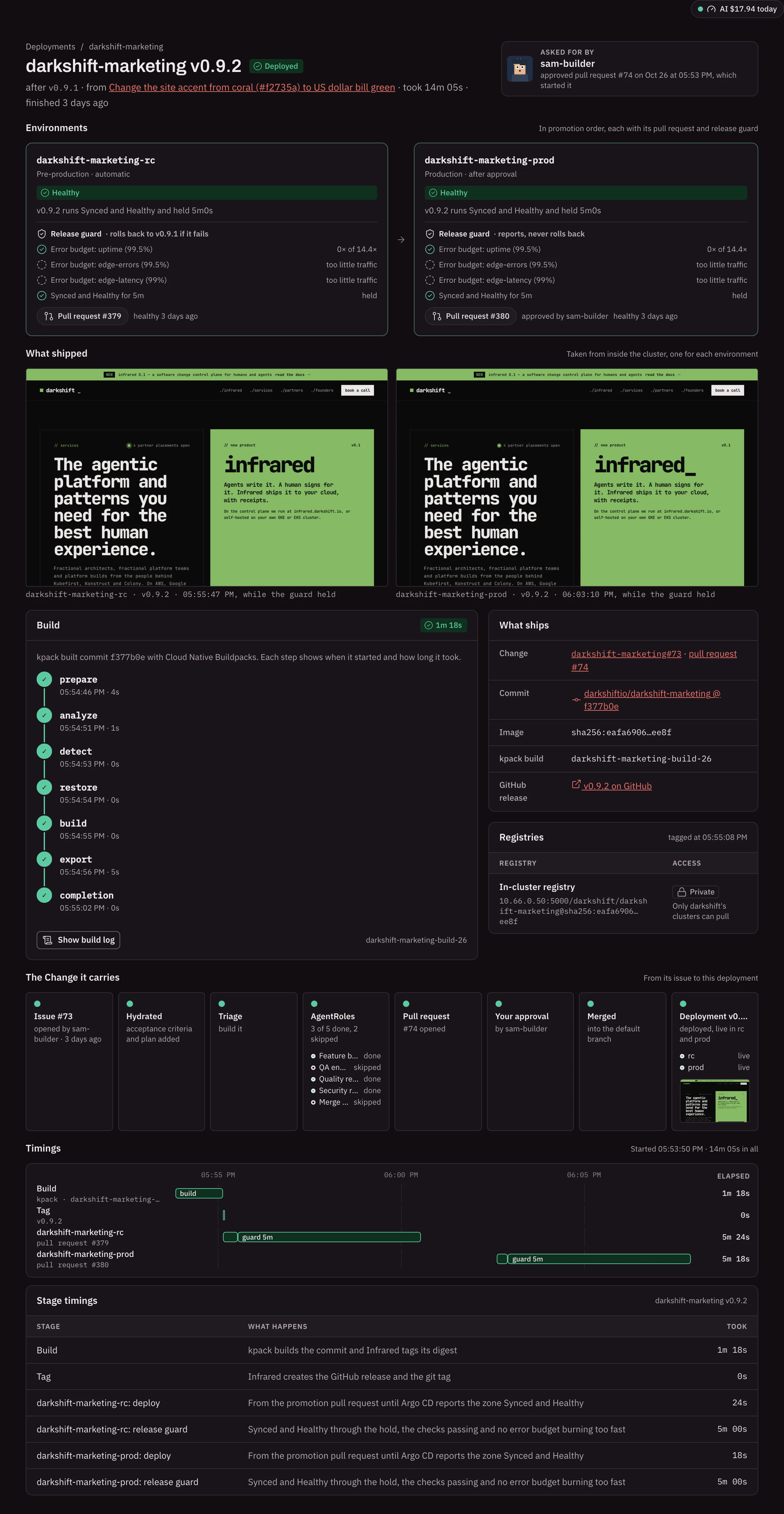
One version on its way through its environments: what ships, each zone's state, the release guard watching it, and where the lead time went.

  • Every push to the default branch deploys
  • A failing zone rolls back by itself
  • Production waits for your approval
Deployments in the docs →
infrared.darkshift.io
A deployment's page: its environments, release guard, what ships and the timings
releases

Releases

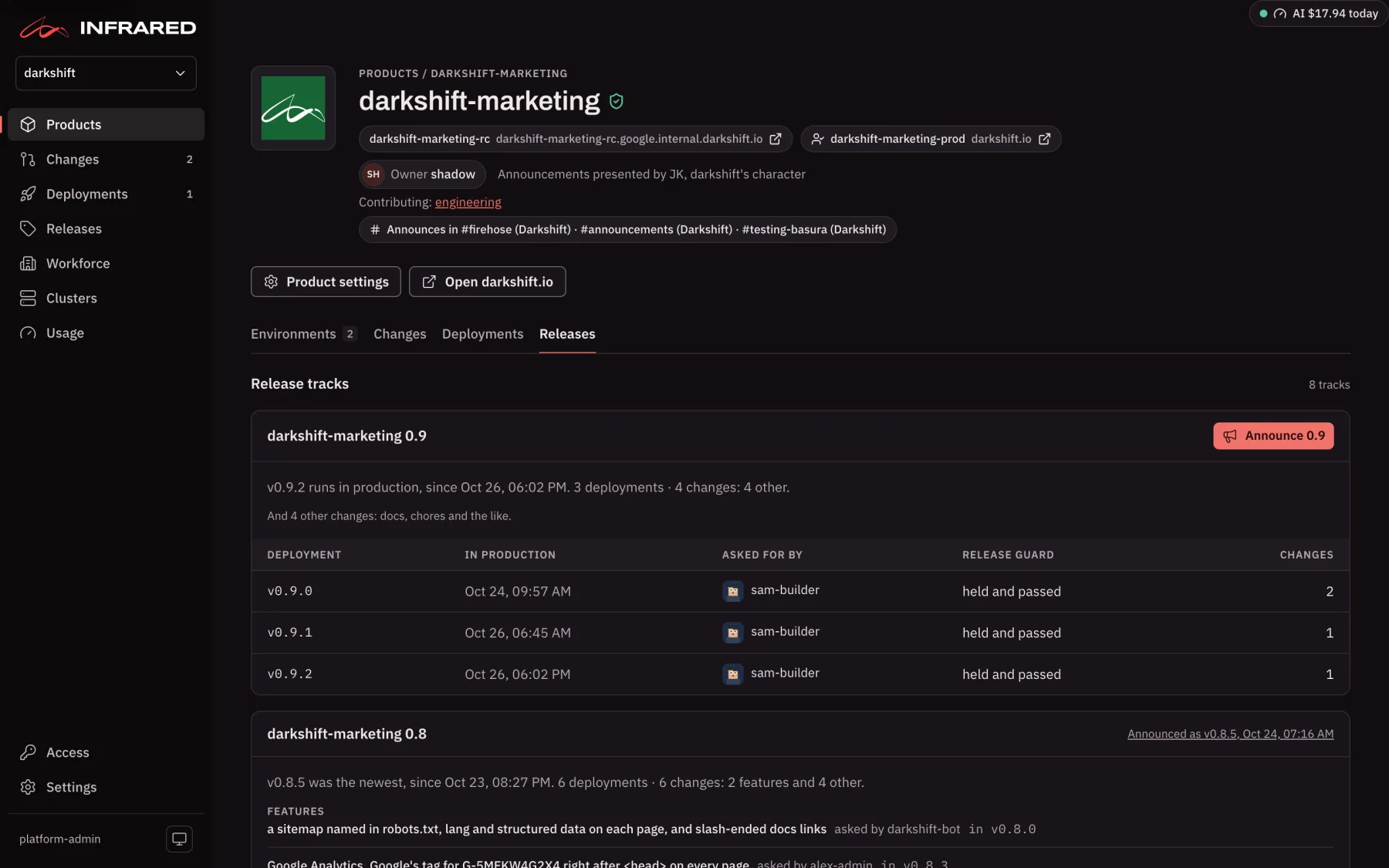
When enough has reached production, Infrared nudges you to cut a release, drafts the notes for engineers and a post for everyone else, tags it and publishes the GitHub release.

  • Release tracks you announce at the version production runs
  • Notes and a post from your conventional commits
  • A page for each release, ready to share
Releases in the docs →
infrared.darkshift.io
A Product's Releases tab: the nudge, its release tracks and Announce a release
workforce

Workforce

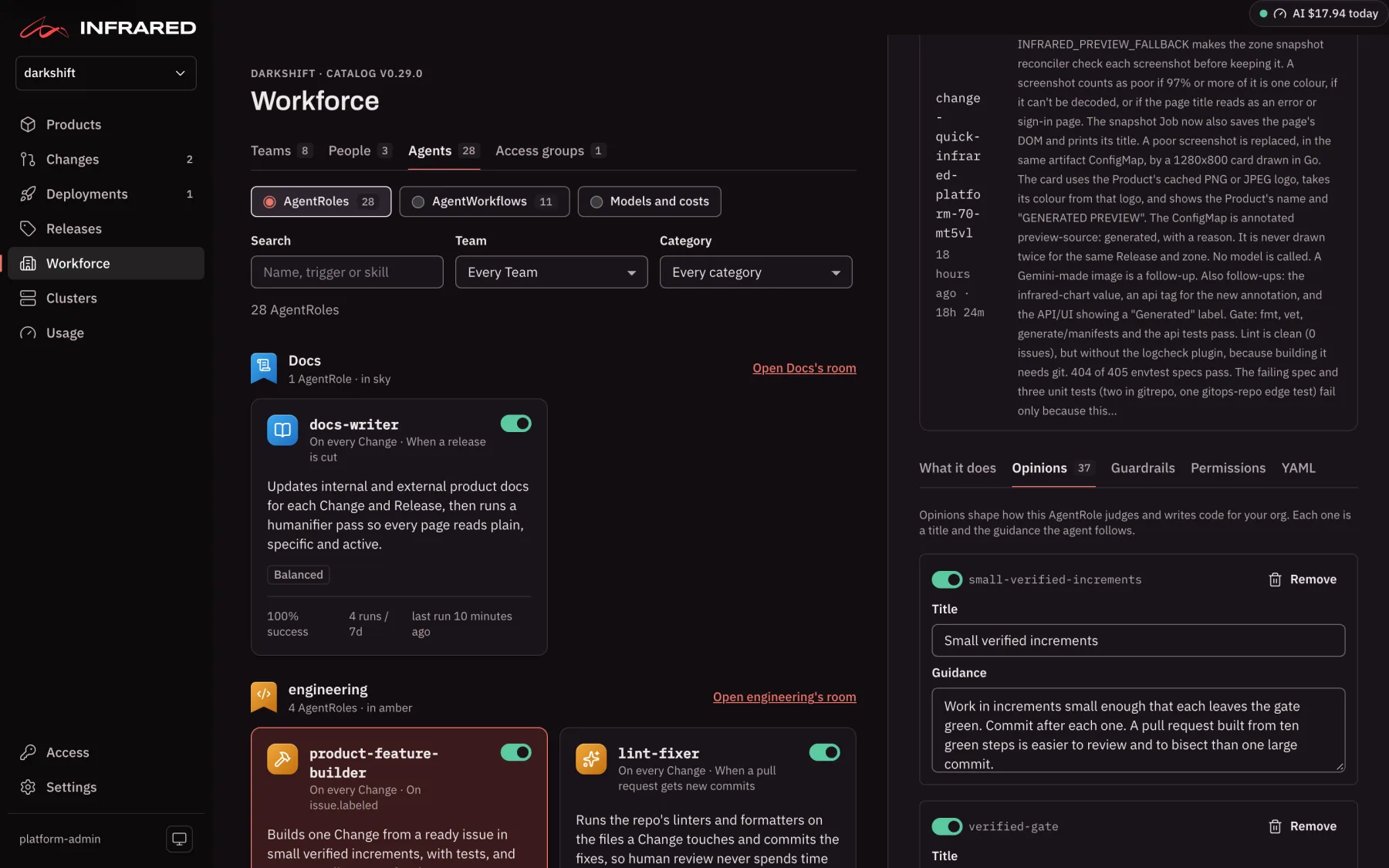
Teams, people, agents and access groups in one area. Agents are grouped by Team, and each AgentRole's opinions, guardrails and success criteria are yours to edit.

  • Eight default Teams in every org
  • Budgets and a circuit breaker per AgentWorkflow
  • Frontier, balanced and fast model tiers
Workforce in the docs →
infrared.darkshift.io
An AgentRole's opinions: the rules it follows, each one editable or switched off
clusters

Clusters

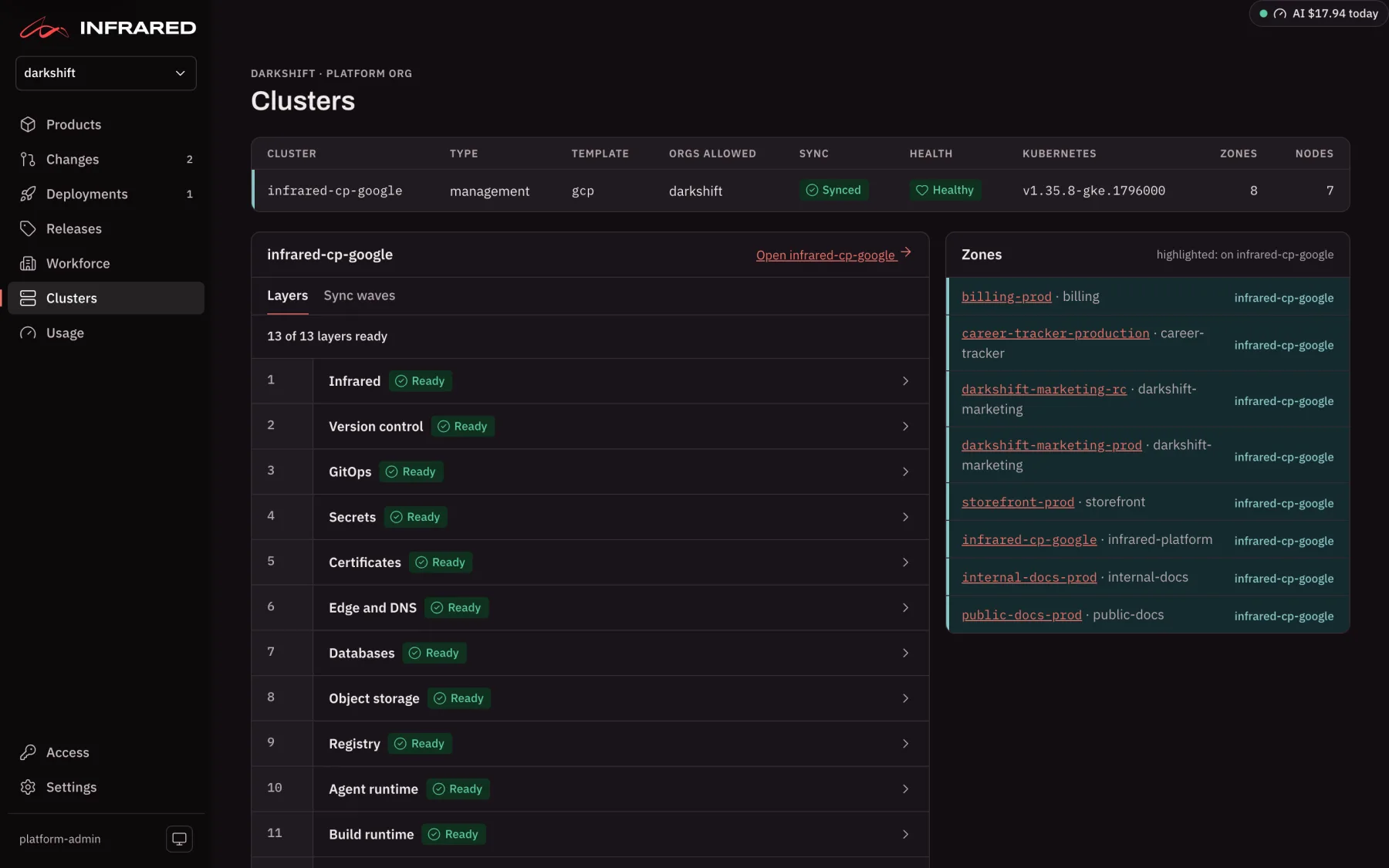
Infrared builds GKE and EKS clusters from templates through cloud accounts that hold no keys, registers any other cluster by its kubeconfig, and deletes one cleanly when you're done.

  • Templates proven on a schedule
  • An org's own clusters, on its own cloud bill
  • Deletion that shows what it removes and what it costs first
Clusters in the docs →
infrared.darkshift.io
Clusters: the management cluster and workload clusters, with their zones and health
usage

Usage

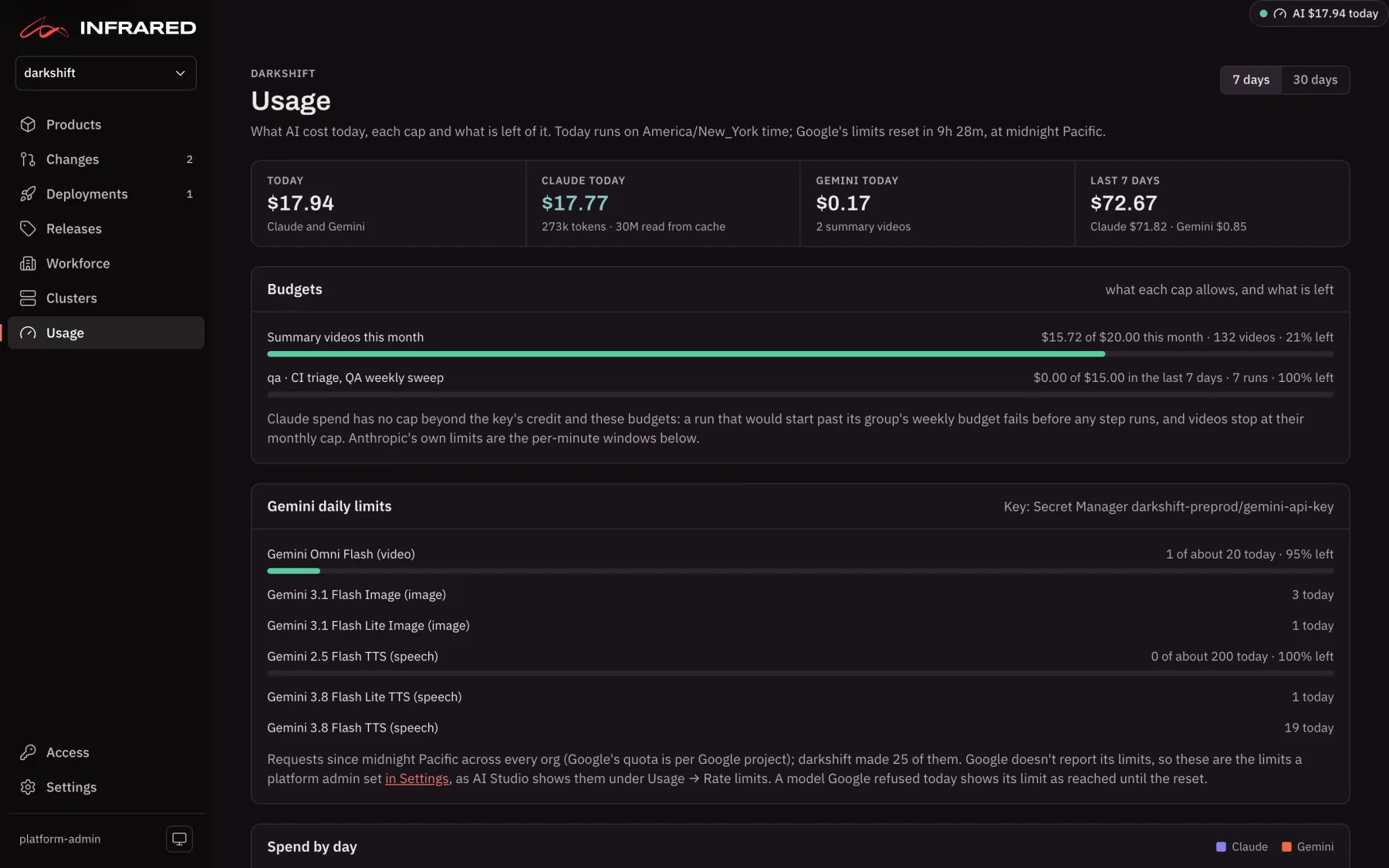
What your agents spend, today and by day, by model and by AgentRole, against the budgets you set. Every page shows a chip with today's spend.

  • Your own Anthropic key, per org
  • Budgets with what is left
  • Rate limits before they bite
Usage in the docs →
infrared.darkshift.io
Usage: today's spend, budgets, video limits and spend by day
// the crew

A crew of AgentRoles, each with one job.

Every org starts with the default catalog, and every AgentRole in it is yours to edit, switch off or add to. The guidance each one follows is written as your org's opinions.

ArchitectTurns a sentence into a planned issue, answers questions about your Products, and reviews releases.
Product feature builderWrites the Change on a branch, against the plan and its success criteria.
QA engineerDecides whether the code or the test is wrong, works fixes out with the builder, and sweeps the suite each week.
Quality, security and policy reviewersRead every Change and pass it, send it back, or block it, with their reasons.
Performance and SRE reviewersCheck what a Change does to speed, cost and reliability before it ships.
Docs writer and version managerKeep the docs current and decide the semver impact of every Change.
CI resolver and merge-conflict resolverFix a red build and untangle conflicts so a Change can land.
WatchersDaily security, performance and SRE audits that open issues for what they find.
the whole catalog →
// under the hood

Kubernetes and gitops, all the way down.

Infrared runs on a Kubernetes cluster we call the management cluster: its operator, API, UI and MCP server, with Argo CD syncing everything from a gitops repo you own. Agent steps run as short-lived Jobs behind a network fence. Your Products run in zones on that cluster or on the workload clusters Infrared builds for you.

kubernetesargo cdgitopsgkeeksopentofugithub or giteaclaudemcpcloudflare
the architecture →
// watch it work

See it for yourself.

Two real videos Infrared made for darkshift's own org: one Change, and one week.

a change's summary video⤢ fullscreen
A summary video Infrared made when a Change to this website finished. The scenes about the people who approved it are cut here.
the weekly video⤢ fullscreen
Part of darkshift's weekly video: the week at a glance, the busiest day and how delivery flowed.

Put Infrared to work.

Run it on the control plane we host, or in your own cloud. Either way, we'll be beside you for your first Changes.